

Drone License Cost in 2026: FAA Part 107 Cost Breakdown

May 12, 2026
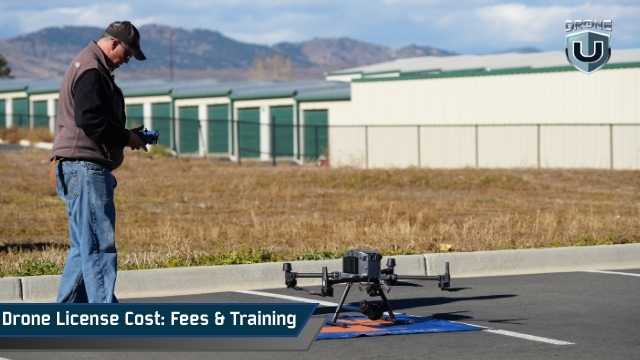
A drone pilot license costs about $175 in required fees in 2026—that’s the Part 107 knowledge test—plus $5 per drone to register with the FAA. Everything else is optional. You choose how much more to spend based on how you study, where you test and how you plan to fly.
What Does a Drone Pilot License Cost in 2026?The FAA says knowledge testing centers charge approximately $175 for the initial Part 107 test. Add $5 per drone for Part 107 registration, valid for three years. Here’s the quick version:
|
Here’s the truth. Only one cost stands between you and the certificate itself: the knowledge test. When the Federal Aviation Administration (FAA) answers “how much does it cost to get a remote pilot certificate,” the test is the only cost it lists. Drone registration is a separate $5 per aircraft.
This guide breaks down the full drone license cost in 2026. You’ll see what you must pay, what you can skip, and what to budget long term. We only list costs we can verify, so you won’t find made-up “average budget” ranges here. If you want the fastest path, our $147 Part 107 course is the one optional cost we’d actually recommend.
When people say “drone pilot license,” they mean the FAA Part 107 Remote Pilot Certificate. It’s the certification you need if you fly a drone for anything beyond pure recreation. If your flight helps you make money, promote a business or support a job, the FAA treats it as a non-recreational operation, and recreational rules no longer cover you.
You need a Part 107 certificate for drone photography, video production, inspections, mapping, construction, agriculture, or public safety support. The rule applies even if the payment is indirect. A “free” flight for a client’s marketing still counts.
To qualify, the FAA requires you to be at least 16, able to read, speak, write and understand English, and in a physical and mental condition to fly safely. Then you pass the knowledge test. That’s why the test fee is the center of every drone license cost breakdown.
If you fly solely for fun under the FAA’s recreational rules, you don’t need a Part 107 certificate. But the moment your flying supports any professional purpose, certification is required. Flying commercially without it can lead to FAA fines that cost far more than the license itself.
Here’s every cost on the path to a Part 107 certificate, and which ones are required.
|
COST ITEM |
DETAILS |
COST |
REQUIRED? |
| FAA Part 107 knowledge test | In-person test at an FAA-approved knowledge testing center. Charged per attempt. | About $175 (per the FAA) | Required |
| Drone registration | Register each drone you fly under Part 107 on FAADroneZone. Valid 3 years. | $5 per drone | Required |
| Free study materials | FAA testing supplement and Drone U’s free Part 107 study guide and practice test. | $0 | Optional |
| Drone U Part 107 course | Video lessons, FAA-aligned quizzes, downloadable study guide, lifetime access, 14-day money-back guarantee. | $147 (regularly $197) | Optional |
| Drone U membership | Includes the Part 107 course plus all other Drone U courses. Renews monthly; cancel anytime. | $97/month | Optional |
| Testing center travel | Fuel, parking or transit, depending on how far the nearest center is. | Varies | Varies |
| Recurrent training | FAA online course (ALC-677) every 24 calendar months. | $0 | Required to stay current |
| Minimum required cost | Knowledge test plus one drone registration, self-study with free materials. | About $180 |
Before deciding how much to spend on preparation, it helps to know exactly what you’re required to spend. Here’s the full path using only free materials and mandatory fees:
Total: about $180.
The only real risk of the free route is a retake. Fail once and you pay the test fee again, and 14 CFR 107.71 makes you wait 14 calendar days before you can retest.
The FAA Part 107 exam is the foundation of your drone license cost. It’s the one fee you can’t avoid. If you spend nothing else, you still pay for this test.
According to the FAA, knowledge testing centers charge approximately $175 for the initial aeronautical knowledge test. You pay it every time you sit the exam. So if you fail and retake it, you pay again. That’s why preparation matters: passing on your first try keeps your total drone license cost as low as possible.
The fee covers one in-person testing session at an FAA-approved knowledge testing center. That includes the exam, scoring and your official test report. It doesn’t include study materials, practice tests or training courses.
First, get your FTN in IACRA. Then book the test with the FAA’s authorized testing provider and pay when you book. Confirm the exact price at checkout, since the FAA describes it as approximate. Once you pass, you apply in IACRA, clear the TSA check, and print your temporary certificate while the permanent card is mailed.
No. Starting October 26, 2026, the FAA is adding image-based questions drawn from current sectional charts to the Part 107 test. The fee and the format—60 scored questions, two hours, 70% to pass—stay the same. What changes is how well you need to read a chart. Our breakdown of the Part 107 test changes covers what to study.
| Pro Tip from Drone U: A retake costs you another test fee plus a 14-day wait. A few hours with a practice test before you book costs nothing. Take ours first, and don’t schedule until you’re scoring consistently. |
After the exam fee, your drone license cost depends on how you prepare. The FAA doesn’t require a paid course. You don’t need a classroom program, a coaching package or a subscription to sit for the test. Still, many pilots spend here to save time and reduce retake risk.
If you’re comfortable learning on your own, the FAA provides free handbooks and the official Airman Knowledge Testing Supplement. Download them, study at your own pace, and you’ve spent nothing beyond the test fee.
Drone U also offers a free Part 107 study guide that walks through test topics in plain language. It’s a useful middle ground if you want structure without a paid course.
Our Part 107 course is $147 (regularly $197). You get on-demand video lessons, FAA-aligned quizzes (score 90%+ and you’re ready), a downloadable study guide, access to the private Drone U community, lifetime access and a 14-day money-back guarantee.
It focuses hardest on the tough stuff—sectional charts, controlled airspace and weather—which is exactly where the October 26 change adds pressure. Many students finish in 7–14 days with 1–2 hours a day. In other words, it costs less than a single retake.
If you plan to keep training after the test, a Drone U membership is $97/month and includes the Part 107 course plus our full course library, monthly coaching calls and the members-only Work & Opportunity section for job leads. It renews monthly, and you can cancel anytime.
| Factor | Free study route | Drone U Part 107 course |
| Cost | $0 | $147 (regularly $197) |
| Best for | Disciplined self-learners with time to research | Pilots who want a clear path and a readiness check before they book |
| Retake risk | Higher if gaps in self-study show up on test day | Lower, because the quizzes show you when you’re ready |
| Support | On your own | Private Drone U community |
| Access | FAA materials anytime | Lifetime access, 14-day money-back guarantee |
If you’re comfortable studying independently, the free route works. If you want to pass on the first attempt and avoid paying the test fee twice, a structured course pays for itself. Comparing more options? See our guide to drone pilot training online.
When you think about drone license cost, it’s easy to focus only on the exam fee. But you must take the Part 107 test in person at an FAA-approved testing center, and that can add real cost depending on where you live.
Not every city has a nearby testing location. If you live near a major metro area, you might drive a short distance and be done in a few hours. In a rural area, however, you may need to travel to another city just to take the test.
Travel can mean fuel, parking, transit or even an overnight stay. There’s also the time cost. You may need to take time off work or push back paid flights while you wait for an open slot. These costs never show up on an FAA fee chart, but they still affect your total.
Testing centers can fill up, so book early. Scheduling ahead and choosing the closest center keeps your overall drone license cost lower and more predictable.
Many new pilots think the drone license cost is one-and-done. It almost is. Your certificate doesn’t expire, but your aeronautical knowledge recency does.
Under 14 CFR 107.65, you must complete recurrent training within the previous 24 calendar months to act as remote pilot in command. The FAA’s recurrent course, ALC-677, is online and open to any Part 107 certificate holder, even if your currency has lapsed. There’s no testing center and no second exam fee.
Zero. The FAA lists its recurrent courses as no cost, and the course page estimates about two hours to complete. So after you pass the initial test, your ongoing FAA cost to stay current is nothing. For the step-by-step, see our guide on how to renew your Part 107.
Beyond the exam and training, a few smaller items affect your total. They’re easy to miss, but they matter once you start flying under Part 107.
You must register your drone with the FAA before you fly it under Part 107. Registration is separate from your pilot certificate. The FAA charges $5 per drone, and each registration is valid for three years. So if you fly three drones, you pay $15.
Your drone must meet Remote ID rules, either with built-in broadcast Remote ID or an add-on broadcast module. Many current camera drones have it built in. If yours doesn’t, budget for a module, and check the price with the manufacturer.
The FAA doesn’t require drone insurance. Many clients do, though, especially for commercial and construction work. Premiums depend on your coverage and the work you do, so get quotes before you price your first job. Our drone insurance guide explains your options.
The TSA security check is part of the FAA application process after you pass the test. If you plan to fly in controlled airspace, you can request LAANC authorization through an FAA-approved app.
It’s also important to know which costs don’t exist. You don’t need a state-level drone license, and you don’t need a business license to take the test. These myths often make a drone pilot license seem pricier than it is.
When you look at the drone license cost, the real question is how quickly it pays for itself.
A Part 107 certificate gives you access to commercial flying. Without it, you can’t legally take paid drone pilot jobs like real estate shoots, inspections or mapping work. That limits how you use your drone and who will hire you.
Certification also reduces risk. If you fly commercially without it, the FAA can fine you, and those fines can far exceed what the license costs. Moreover, clients expect it. Many won’t hire an uncertified pilot.
At this stage, the question isn’t whether the drone license costs money. It’s whether staying uncertified costs you more.
Yes, but the certificate alone doesn’t set your rate. Your skills, your niche and your ability to sell do.
Here’s what verifiable data shows. The U.S. Bureau of Labor Statistics doesn’t track “drone pilot” as its own occupation. Its closest category, Electro-Mechanical and Mechatronics Technologists and Technicians, lists “Unmanned Air Systems Operator” as an example title and had a median annual wage of $73,900 in May 2025. That category also includes non-drone technicians, so treat it as context, not a drone salary.
Job postings give a sharper snapshot. For example, Amazon Prime Air’s Flight Monitor role requires a Part 107, and the postings we reviewed in October 2026 listed $35 per hour. Our post on Amazon drone pilot jobs covers those roles, and our drone pilot salary guide covers freelance pricing.
Either way, the test fee and a $147 course are small next to a single paid job. The bigger variable is how quickly you build skills and clients.
The required cost of a Part 107 drone license is small and predictable: about $175 for the test, $5 per drone to register, and $0 every two years to stay current. What varies is how efficiently you get there.
Some pilots self-study and pay only the minimum. Others choose structured training for speed and confidence. Neither approach is wrong. What matters is matching your spend to your goals and your timeline.
Wondering how to pass your Part 107 exam on the first try? Enroll in the Part 107 course for $147 (regularly $197). You get lifetime access, FAA-aligned quizzes, a downloadable study guide and a 14-day money-back guarantee, built on 10+ years of in-person drone training and 14+ years of online drone education.
Training a team? Our enterprise drone programs cover group Part 107 prep and hands-on Flight Mastery training, and Drone U offers continuing education credits for organizations. Book a consultation to get a plan for your organization.
Sources
 1
1
